
By: Sabine Ehgoetz, Senior Marketing Specialist
Full Throttle Was Never The Problem
I'll be honest: I know Paul and think highly of him. But I've also read more personal and professional development books and took more courses than I can count, with big names like Simon Sinek, James Clear, Napoleon Hill.
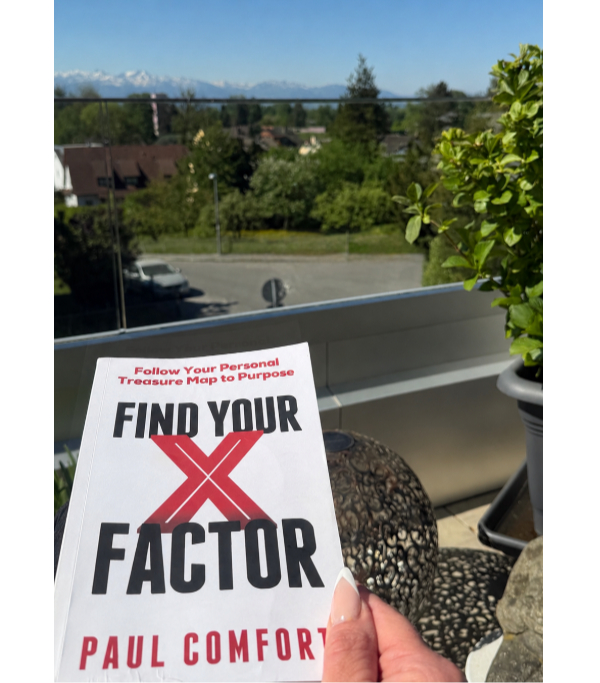
So when I received an early copy of Find Your X Factor, I had the thought most “growth junkies” would have: how different could this one really be?
Different enough that I repeatedly got goosebumps during my read, simply because his words moved something in me, a sensation that’s likely best described with moments of clarity, recognition, when something previously subconscious becomes conscious.
Paul doesn't write to impress you. He writes to reach you. And the way he gets there is through a kind of honesty that's genuinely rare in this genre — where a moment lands and you go “daaaang, that's SO true” and you have to take a moment to let it hit you, let it hit home..
The book opens with an eleven-year-old boy. It's the summer of 1976. Paul and his friend are walking through Annapolis, and he wants to leave his mark on the world. So they carve their initials into a telephone pole. The blade slips. A splinter drives deep under his fingernail. Hours later, a doctor cuts into the nail without anaesthetic to remove it.
And then Paul writes: "What I really wanted was permanence. Significance. A mark. Instead, I got pain and a scar." Isn’t that so much of our life's journeys, in a nutshell?
Isn’t that the whole tension, right there? The desire to matter, the attempt to reach for something larger than yourself — the failure, the pain, and then the scar that wants to remind you that you shouldn't try again. Head down, make no waves, ride it out. Paul puts that alternative on the table plainly. And then asks: is that what you want?
The central idea — your X Factor lives at the intersection of your deepest passions and your greatest abilities — is rendered as a treasure map. The X is already somewhere on your map, it already lives within you, and it only needs to be found - that’s an attractive promise. The book gives you the tools to read the terrain. The concept is simple enough. What makes it land is that Paul never lets it float at the level of idea — every truth is grounded in a moment, a person, a story you can feel. That's what separates this from the books that sound good, but have been forgotten by Tuesday.
Chapter 12 was the one that truly inspired and ignited me and one EVERY leader needs to read: The Change Agent vs. Cheerleader framework — using Steve Jobs, Tony Dungy, and Abraham Lincoln as lenses — is one of the clearest explorations of leadership style I've come across. The reason it works is that Paul never positions himself above the experience. He's in it with you — someone who has worn both jerseys, made both mistakes, and is reporting back from the field rather than from the podium. "Leadership isn't about choosing one note and playing it on repeat. It's about knowing the full melody and reading the room." That's someone writing from scar tissue, not theory.
For me, the question underneath that chapter was personal. I go 150 percent into most things. I always have. And I've spent real time wondering whether that intensity is genuine drive or ambition dressed up as purpose. Paul answered it in Chapter 21, and the answer was direct: "Fulfillment doesn't come from self-protection or self-indulgence. It comes from service, from stretching, from risking, from going full throttle."
That sentence landed somewhere specific. The full-throttle was never the problem. The question was always whether it was pointed at something worth giving myself to.
Paul also draws a quiet but firm line between success and significance, leaning on a John Maxwell observation he clearly lives by: "Success is when I add value to myself. Significance is when I add value to others." That reframe does something to how you think about the arc of a career, and a life.
Reading this book also helped me name something in myself that had been present but was still somewhat shapeless. The drive to surface what's hidden — the meaning beneath the surface, the structure inside the chaos — and then express it in language that makes the person on the receiving end feel genuinely understood. That's my intersection. This book gave me the full awareness of my own X Factor, and the vocabulary to say it plainly.
I didn't need Paul's résumé for any of this to land. I needed his willingness to go back to the eleven-year-old with the pocketknife and say: the scar is evidence you were brave enough to leave a mark. The lesson isn't to stop reaching or climbing the ladder. The lesson is to make sure it leans against the right wall.